



From Pentaho to DFM 2.0: Modernizing Enterprise Data Flows with Agentic AI

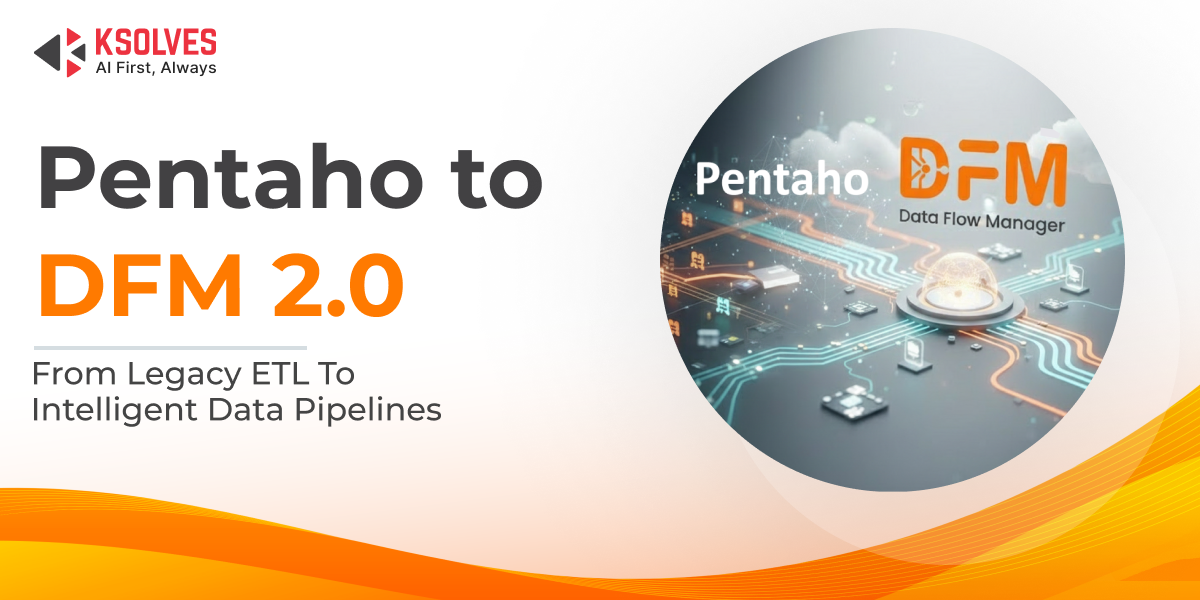
For years, Pentaho has been a dependable ETL platform for enterprises managing structured data pipelines. It helped organizations design, schedule, and execute batch transformations across databases, files, and warehouses.
But today’s enterprise data landscape looks very different.
- Real-time event streams coexist with batch workloads.
- Hybrid and multi-cloud environments are the norm.
- Data governance and observability are board-level priorities.
- Infrastructure costs demand continuous optimization.
The question is no longer just: “Can we move data from A to B?”
It is: “Can we intelligently control, optimize, and govern our data flows at scale?”
This is where the transition from Pentaho to DFM 2.0 becomes strategic. This blog explores how organizations can migrate from Pentaho to DFM 2.0 and modernize their data flows.
The Limitations of Traditional ETL with Pentaho
Pentaho (Kettle) is built around a job and transformation-centric architecture. While powerful for batch ETL, modern enterprise demands expose certain constraints.
- Primarily Batch-Oriented Design
Pentaho excels at scheduled transformations. However:
- Its streaming capabilities, while available in Enterprise Edition through Kafka and AMQP consumer steps, were designed as extensions to a batch-first architecture rather than as a native streaming engine.
- Handling high-throughput event-driven pipelines at scale often requires architectural workarounds.
- Scaling streaming use cases often involves additional tooling beyond core Pentaho.
In contrast, modern architectures demand continuous data movement, not just nightly jobs.
2. Operational Overhead and Reactive Monitoring
Pentaho deployments typically rely on:
- Job logs
- External monitoring tools
- Manual failure investigations
As environments grow:
- Debugging becomes time-consuming.
- Root cause analysis spans multiple systems.
- Teams operate reactively rather than proactively.
There is no unified control plane governing multiple environments.
3. Limited Native Observability
In large-scale data ecosystems:
- Visibility into transformation-level performance is fragmented.
- Infrastructure consumption is difficult to correlate with pipelines.
- Identifying bottlenecks across environments requires manual correlation.
Observability becomes a tooling challenge instead of an architectural feature.
4. No Built-In Intelligence Layer
Pentaho executes what it is told to execute.
It does not:
- Predict pipeline failures.
- Recommend performance optimizations.
- Detect anomalous data flow behavior.
- Support policy-driven remediation workflows for stuck or underperforming jobs.
In modern enterprise environments, this gap becomes significant.
Why Migrate from Pentaho to DFM 2.0?
DFM 2.0 is not simply another ETL tool.
It is an Agentic AI-powered control plane for enterprise data flows, built around Apache NiFi and modern distributed architectures.
Where Pentaho focuses on executing transformations, DFM 2.0 focuses on:
- Centralized governance
- Real-time observability
- Flow orchestration
- Cost optimization
- AI-driven operational intelligence
It transforms data movement into a managed, optimized, and intelligent system.
Architectural Shift: From Jobs to Flows
Pentaho Model
- Job-centric execution.
- Transformation pipelines triggered on schedule.
- Limited awareness of distributed cluster behavior.
DFM 2.0 Model (Built Around Apache NiFi)
- Flow-based programming paradigm.
- Directed graphs of processors handling streaming and batch data.
- Back-pressure management.
- Native queuing and prioritization.
- Horizontal scalability across clusters.
Apache NiFi enables continuous, event-driven processing, and DFM 2.0 acts as the centralized control and intelligence layer on top of it.
Also Read: How Agentic AI Transforms Apache NiFi Operations
Key Capabilities of DFM 2.0 That Extend Beyond Pentaho
1. Agentic AI for Flow Optimization
DFM 2.0 introduces intelligent agents that:
- Continuously monitor flow performance.
- Detect bottlenecks in processors and queues.
- Identify abnormal throughput patterns.
- Recommend configuration changes.
- Surface flow-level inefficiencies through centralized monitoring.
Instead of waiting for failures, the system anticipates them. This is a shift from rule-based automation to adaptive intelligence.
2. Centralized Multi-Cluster Control Plane
Large enterprises often operate:
- Multiple NiFi clusters.
- Dev, QA, and Production environments.
- Hybrid or multi-cloud deployments.
DFM 2.0 provides:
- A single pane of glass for all environments.
- Cluster-wide visibility.
- Cross-environment governance.
- Centralized operational policies.
This eliminates fragmented monitoring and siloed management.
3. Real-Time Observability and Monitoring
DFM 2.0 enhances observability by providing:
- Flow-level health dashboards.
- Throughput and latency tracking.
- Queue depth monitoring.
- Failure trend analysis.
- Historical performance analytics.
Operational insights are no longer log-dependent; they are visual, actionable, and centralized.
4. Proactive Alerts and Policy-Driven Remediation
With Agentic AI:
- Anomalies are detected before SLAs are breached.
- Early signs of resource saturation are identified and flagged.
- Stuck processors are identified automatically.
Policy-driven remediation workflows can be triggered within enterprise-defined guardrails.
This reduces manual firefighting and improves pipeline reliability.
5. Cost Optimization Insights
In distributed data environments, infrastructure costs often grow unnoticed.
DFM 2.0’s centralized monitoring provides:
- Flow-level and cluster-level resource utilization visibility.
- Identification of idle processors and backpressure-related inefficiencies.
- Queue behavior patterns that correlate with unnecessary resource consumption.
- Cluster health metrics across environments.
By surfacing these flow-level inefficiencies, teams can make better-informed infrastructure decisions and address cost drivers before they escalate.
This is particularly critical in cloud and containerized deployments.
6. Governance and Policy Enforcement
Modern data ecosystems require strict governance.
DFM 2.0 supports:
- Role-based access control.
- Flow versioning oversight.
- Centralized audit visibility.
This enables enterprises to maintain compliance while scaling data operations.
Business Benefits of Migrating from Pentaho to DFM 2.0
Modernizing from Pentaho to DFM 2.0 is not just a technical upgrade — it is an operational transformation. The shift introduces intelligence, visibility, and governance across the entire data lifecycle.
1. Reduced Operational Burden
Traditional ETL environments demand constant monitoring and manual troubleshooting. DFM 2.0 fundamentally changes this dynamic.
- Intelligent anomaly detection reduces manual log analysis.
- Automated alerts surface issues before they escalate.
- Centralized control eliminates fragmented monitoring tools.
Instead of firefighting pipeline failures, data teams move toward proactive optimization and strategic improvements.
2. Higher Reliability and Stability
In distributed environments, even small bottlenecks can cascade into major disruptions. DFM 2.0 strengthens pipeline resilience through:
- Proactive anomaly detection powered by AI agents.
- Native back-pressure handling in flow-based architectures.
- Continuous, flow-aware health monitoring across clusters.
The result is significantly improved pipeline stability, reduced downtime, and stronger SLA adherence.
3. Faster Time-to-Insight
Batch-only pipelines limit how quickly businesses can react to data. By transitioning to a flow-based, real-time architecture:
- Data moves continuously instead of waiting for scheduled jobs.
- Latency is reduced across ingestion and processing layers.
- Streaming and batch workloads coexist seamlessly.
Business teams gain near real-time access to insights, enabling faster decisions and improved responsiveness.
4. Infrastructure Cost Optimization
As data environments scale, costs often grow without visibility. DFM 2.0 introduces financial accountability into data operations.
- Clear visibility into cluster and flow-level resource usage.
- Identification of idle processors and backpressure-related inefficiencies.
- Data-driven scaling and capacity planning decisions.
Organizations can optimize compute consumption, reduce waste, and align infrastructure investments with actual business value.
5. A Future-Ready, Intelligent Architecture
Moving from Pentaho to DFM 2.0 enables a foundational architectural shift:
- Batch-centric pipelines evolve into event-driven, scalable data flows.
- Hybrid and cloud-native deployments become easier to manage.
- AI becomes embedded within operational workflows.
This is not just modernization. It is the transition from static ETL execution to intelligent, adaptive data operations.
Who Should Consider This Migration?
The shift from Pentaho to DFM 2.0 is not for incremental improvement, but it is for organizations ready to modernize how data operations are governed, optimized, and scaled.
- Enterprises Operating Large Pentaho ETL Landscapes
Organizations running extensive Pentaho transformations across departments, business units, or geographies, especially those facing increasing maintenance complexity and scaling challenges. They will benefit from a centralized, flow-based control plane.
- Organizations Transitioning to Real-Time and Event-Driven Architectures
If your business is moving beyond batch processing toward streaming, APIs, and event-driven systems, DFM 2.0 provides the architectural foundation to support continuous, low-latency data movement at scale.
- Data Engineering Teams Facing Monitoring and Operational Complexity
Teams struggling with fragmented monitoring tools, reactive troubleshooting, and limited visibility across environments can gain unified observability and AI-assisted operational intelligence with DFM 2.0.
- CIOs and Technology Leaders Embedding AI into IT Operations
Leaders seeking to introduce intelligent automation, proactive monitoring, and cost-aware infrastructure management into data operations will find DFM 2.0 aligned with broader AI-driven transformation initiatives.
- Enterprises Standardizing on Apache NiFi or Modern Data Platforms
Organizations adopting Apache NiFi for distributed data flows, particularly in hybrid or multi-cloud environments, can leverage DFM 2.0 as a centralized governance and optimization layer to maximize scalability, reliability, and control.
Final Words
Pentaho helped enterprises standardize and automate traditional ETL. But today’s data environments demand more than scheduled jobs and reactive monitoring. Modern organizations need real-time processing, centralized governance, cost visibility, and intelligent optimization built directly into their data architecture.
The shift from Pentaho to DFM 2.0 is not just a platform change, but it is a move from static ETL execution to intelligent data flow management. By combining Apache NiFi’s flow-based model with an Agentic AI-powered control plane, DFM 2.0 enables proactive operations, greater reliability, and scalable, future-ready data ecosystems.
Ready to move from traditional ETL? Start your journey toward intelligent, flow-based data operations with DFM 2.0 today.
Schedule a Free Demo


 1800 121 0218
  +1 (646) 203-1075
  +91 8527471031
 sales@ksolves.com